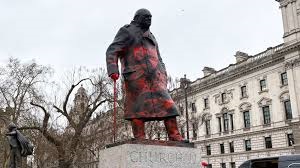
When activists linked to Palestine Action sprayed red graffiti across the statue of Winston Churchill in London, they were not exercising protest, they were committing criminal damage in one of the country’s most symbolically significant civic spaces. Slogans accusing Churchill of being a “Zionist war criminal” were daubed across a monument that represents not merely stone and bronze, but Britain’s wartime survival and democratic endurance.
Disagreement over foreign policy, anger about Gaza, or hostility toward Israel does not grant anyone a licence to vandalise public monuments. Britain robustly protects free speech. It protects peaceful marches. It protects the right to criticise governments, past and present. What it does not protect and must never normalise is the deliberate destruction of shared national heritage for political theatre.
This incident does not stand alone. Activists associated with Palestine Action have, in the past, escalated from demonstrations to direct-action break-ins and property damage at facilities operated by Elbit Systems in Britain. Equipment has been damaged. Operations have been disrupted. Arrests and prosecutions have followed. Each time, the justification is framed as moral urgency. Each time, the method is criminal damage. Now, the tactics appear to be broadening from industrial targets to national monuments. The UK government must reject this trajectory unequivocally and make clear that political grievances, however strongly felt, do not justify the destruction of property.
This is the moment when the government must draw a visible and immovable line. If vandalism of factories leads to vandalism of statues, what comes next? Public order depends not on selective enforcement but on the consistent application of the law. When political groups test boundaries incrementally, hesitation from authorities can be mistaken for tolerance.
Hate matches and intimidation must not be tolerated on UK streets. Existing laws should be firmly enforced without apology. Those who organise, encourage, or carry out criminal damage must face proportionate consequences. Sentencing guidance should reflect the seriousness of politically motivated vandalism in high-profile civic spaces. Repeat offenders should expect escalating penalties. Where networks are coordinating unlawful acts, investigative scrutiny should follow.
Democracy is not defended by slogans sprayed in the night. It is defended by rules applied equally to all. Britain has weathered far greater storms than this, but only because it has understood a simple truth, freedom without order collapses into chaos. If the line is not drawn now, clearly, confidently, and consistently, others will test it again. The time to act is now.
About the Author